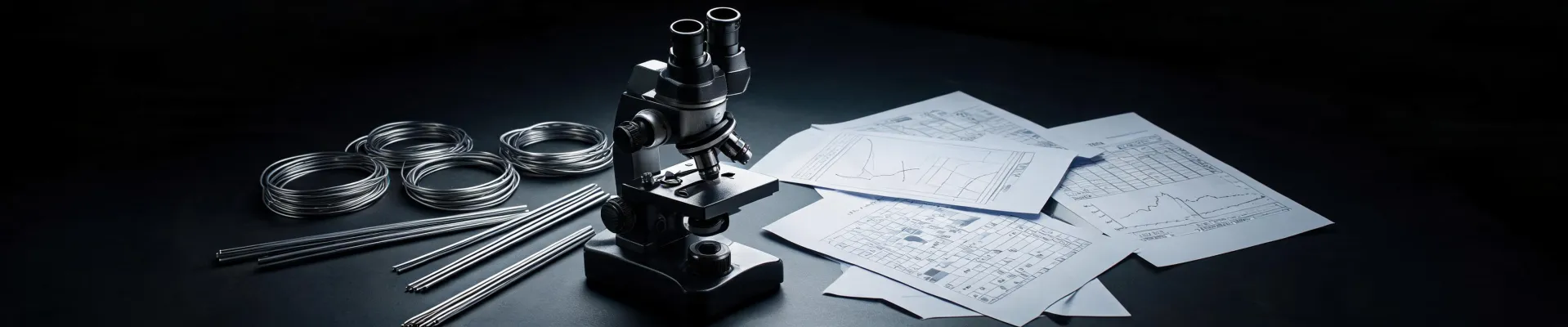
Last month I stood at a slicer in a wafer fab with two spent spools of diamond wire in my hands, one built on a brass-coated core and one on zinc, and the break pattern told me the story before any datasheet did. I am a corrosion engineer, so my job is to work backwards from how metal fails in service, and sawing cable is one of the cleaner cases I get to look at.
A diamond-wire sawing cable is the coated steel core that diamond wire producers build their cutting wire on. The brass or zinc layer on it is not a cosmetic finish; it is the corrosion barrier that decides how long the wire survives the coolant it swims in. That, far more than grit choice, is where a slicing line's break events come from.
What the Sawing Cable Does Before the Diamond Bites
Strip away the diamond and what is left is a fine high-carbon steel wire, drawn down to somewhere between 45 and 120 microns depending on whether it is headed for solar wafering or sapphire. The grit does the cutting, but it never carries the load on its own; the steel core does that, at tensions that would snap a bare wire in minutes. The coating sits exactly at the steel-to-coolant interface, and the coated cable itself never touches the wafer. That separation matters: the cable is specified for survival in a wet, slightly acidic environment while the diamond is specified for cutting. Two different problems, two different products, and the one that shows up in your downtime report is almost always the coating.
Brass Coating and Zinc Coating on the Same Core
The same core leaves the plant with either brass or zinc on it. Brass, a copper-zinc alloy, is the classic bonding layer: diamond electroplating grips it well, and most fixed-abrasive wire is built on brass because the grit stays put during plating. In a coolant carrying free chloride, though, brass becomes the less noble partner; once it is breached it corrodes and takes the steel with it. Zinc works the other way. It is less noble than steel, so it sacrifices itself, giving up its own metal to keep the core intact wherever the coating has been scratched. Bekaert runs both coatings in house, which is why the choice lands on your desk rather than on a subcontractor's. People confuse the sawing cable with the finished diamond wire, but the cable is the substrate, the thing the wire is built on, and that is why its coating chemistry is chosen for survival rather than for cutting speed.
Why the Coating Outlasts the Grit in the Line
When a wire parts on a saw, it is almost never the grit wearing out. It is a corrosion-fatigue event that starts at a coating breach, a spot where bare steel meets coolant, and grows into a crack under the cyclic tension of every pass. Coolant pH drifting below neutral, free chloride from make-up water, and fluid temperature all speed that growth. I have seen a line running at pH 5.8 with 40 ppm chloride chew through a coating in two days that had survived a month at pH 7. A coating that holds under those conditions keeps the wire under tension and the wafer whole; one that does not fails exactly where the breach is, and takes the yield with it.
Three Coating Breaches I Traced Back to the Bath
I keep a small bench kit for spent wire, a stereo microscope and a coating-weight strip test, and three defect types show up again and again, each pointing at a different step upstream.
On a zinc-coated spool from a solar line I noticed a matte, powdery patch on the guide side, dull like old galvanised fence wire. That is bath-chemistry drift, an alloy or pH shift that leaves the zinc porous and fast to burn away. On another spool I found a bright bare stripe running down one flank, no diamond left on it and no coating either. That one was mechanical, a misaligned pulley scraping the coating off, and once the steel is bare, corrosion begins within a single shift. The one that annoys buyers most came from a brass spool that looked perfect under normal light, uniform gold end to end, and still broke at about sixty percent of its expected life. Under magnification the coating was even in colour and uneven in thickness, so it parted at the thin spots.
The cost differed in each case. The zinc patch cost three hours of unplanned downtime; the bare stripe threw a scrapped wafer lot; the pretty brass spool broke near the end of a run and took the batch with it. Every one traced back to a coating variable that a routine check would have flagged before the spool ever reached the saw.
From Steel Rod to Coated Spool, Step by Step
The route from raw rod to a spool of coated sawing cable runs in one direction and does not skip. A high-carbon steel rod is drawn down in stages to the final core diameter, with annealing between passes so the wire stays ductile enough to bend around a guide pulley without cracking. It is then degreased and pickled to strip oxide and oil and leave a clean, active surface, because a coating will not bond to a dirty one. From there it passes through flux and into the coating step, hot-dip or electroplating, where brass or zinc is laid down to a target weight. Diameter and coating weight are checked next, and only after that does the wire get spooled.
If I were auditing a supplier, the step I would stop at is that coating-weight check. A bath drifts slowly, and the first place you see it is a number moving on the gauge, long before it becomes a powdery patch on a guide side. Bekaert states every product runs through strict process and quality control at all manufacturing steps, from raw material up to final product, to keep performance optimal and stable. That claim is proved or disproved by a control chart, and a control chart is entirely fair to ask for.
What Bekaert's Own Claims Tell a Buyers' Engineer
Three supplier statements are worth putting into a spec, read as a floor rather than a ceiling. Bekaert offers both brass and zinc coating in house. Its sawing cable is the core of diamond wire from the world's largest producers, chosen for quality and resilience. And every product goes through strict process and quality control at each manufacturing step, from raw material to final product. None of those gives you a number, so the next move is to ask for the numbers behind them: coating-weight tolerance, minimum coating weight, and the bath-chemistry limits the supplier holds itself to.
Before you place your next order, pull last month's wire-break events and sort them by coating lot. If one lot owns the breaks, request the coating-weight and bath-control records for that batch from your supplier. Within a week you will know whether the problem is the coating or the saw, and that answer, not a price sheet, decides what you buy next.